





Manual of Action
Kembra Pfahler’s work is born of impulse. the impulse to transform the body, to make noise, to invent characters and to disobey the forms we are handed. for more than four decades, the american artist has built her language through this continuous movement of contamination: an experience becomes a song; a song becomes a drawing; a drawing becomes a character; a character becomes a performance. nothing stays in its place for long. everything seems to exist in order to take another form.
It is this organism in permanent transformation that Kembra revisits in manual of action, a new exhibition on view at Yehudi Hollander-Pappi. for the first time in brazil, the multidisciplinary artist and musician turns to the 54 songs she wrote for the voluptuous horror of Karen Black, the band and performance project she created in 1990 and which is inseparable from her trajectory, producing one drawing for each of them. These are songs shot through with different moments of her life (her mother, her father, friendships, encounters and events) that make the exhibition a kind of fragmented autobiography. Not a retrospective arranged in chronological order, but an entire life reactivated through images, sounds and memories.
Everything in Kembra’s universe is born of the songs: the objects, the sculptures, the costumes, the performances. the drawing does not illustrate the music: it is another possible existence for what was once sound. perhaps that is why she describes them as temperamental. sometimes, she says, her hand simply freezes. “i can’t draw unless the drawing wants to be born.” there is something performative in this gesture, too. Kembra draws the bodies of Karen Black in performance and then becomes those bodies. the image precedes the action, and the action returns to the image.
To understand this movement, one must go back to the late 1970s, when Kembra arrived in New York while still very young, carrying with her the impact of the first wave of Los Angeles punk. At 15, on a first trip to the city, she discovered the clubs and spaces that drew her toward experimental music and performance, and that led her to the school of visual arts. her closeness to artists, among them the lithuanian filmmaker Jonas Mekas, would further deepen a practice that has never acknowledged boundaries between film, music and image.
It is in this territory that the voluptuous horror of Karen Black emerges in 1990. Kembra turns the stage into a place where her multidisciplinary production unfolds all at once. body paint, wigs, prosthetics, high heels, glitter and hand-built objects produce an image deliberately pushed to excess. the artist exaggerates codes historically associated with femininity until they lose their stability. beauty and monstrosity thus cease to occupy opposite sides. in Kembra’s work, the grotesque does not deform: it frees her from the obligation to remain recognizable.
This refusal of established forms also runs through the method she has named availabism: making art from whatever is available. using what is at hand, building one’s own costumes and sets, working with simple materials, bringing people together and producing without waiting for ideal conditions. more than a do-it-yourself aesthetic inherited from punk, availabism has become an ethic that runs through her production and that she has taught for decades: creating not out of lack, but out of possibility.
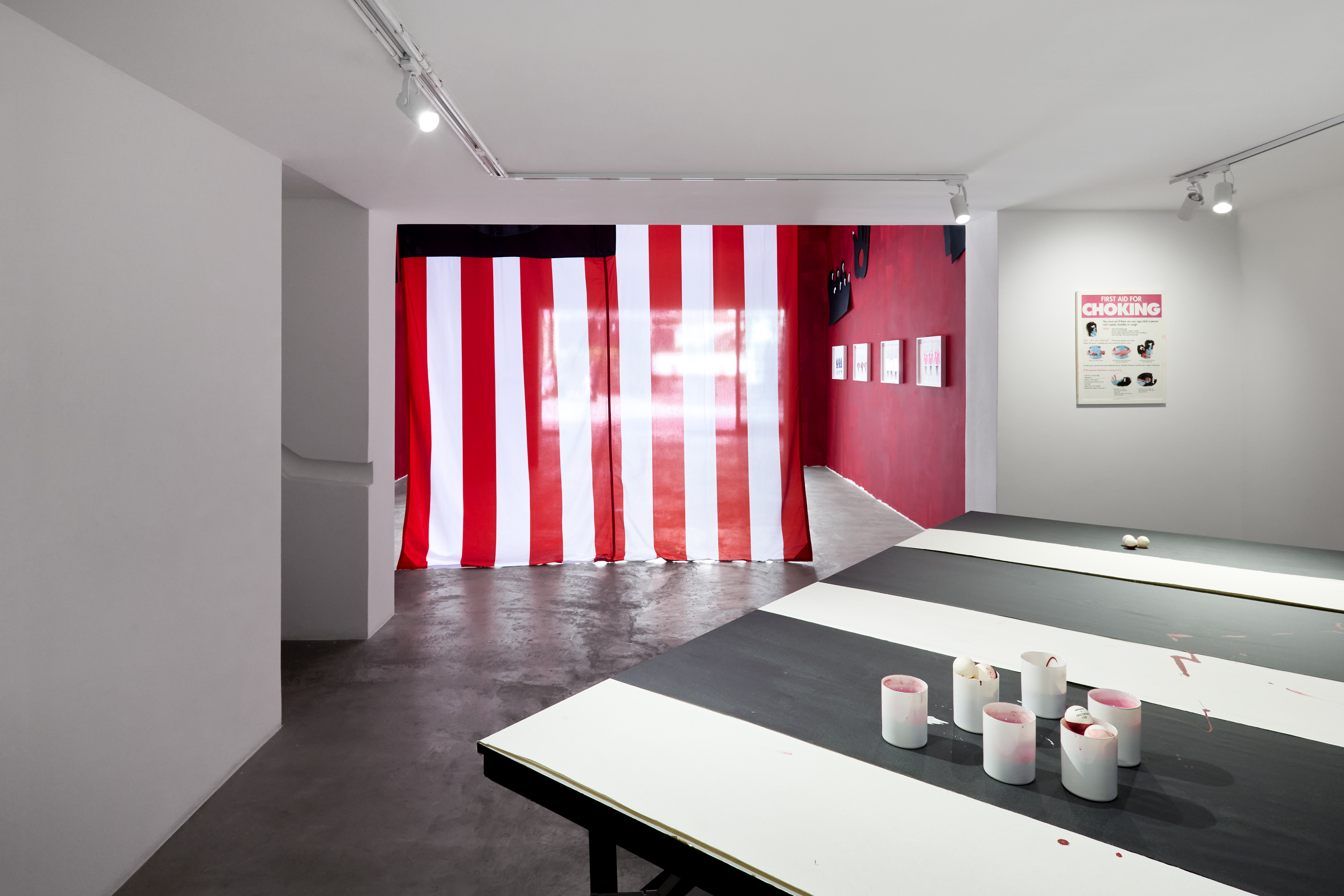
In manual of action, this ethic extends beyond the drawings and reaches the exhibition space itself. Kembra arrived in brazil prepared to find part of the exhibition here: gathering materials from her surroundings, building objects and sets, and allowing São Paulo to intervene in what she had begun to imagine in New York. The work thus remains deliberately open to encounter and to chance. there is an especially potent coincidence in her first exhibition in brazil: manual of action is housed in a building designed by Flávio de Carvalho. Decades before Kembra turned her own body into a field of experimentation, Flávio already understood clothing, architecture and behavior as territories inseparable from performance. in his experiments, getting dressed could constitute an act of insubordination; walking through the city, an artistic action; confronting social conventions, a way of revealing what lay hidden beneath normality.
Manual of action carries, in its title, the appearance of an instruction. But Kembra’s manual does not teach us how to act. Perhaps it simply reminds us that every transformation begins with an action. she draws, builds, sings, dresses, paints the body, gathers people and goes on defending a radically simple idea: to create a different world, it may be necessary to start with what lies within reach of our hands. a body. a space. a song. a piece of paper. and the possibility of making something else of them.