




[1]
Wake
to Juliana Frontin
The past is hidden somewhere outside the realm, beyond the reach of intellect, in some material object… and when by chance we encounter the object that contains it, the past suddenly expands within us.
Sound is dead. It is an endgame. There is only a muffled sound. There is only sound. There is no more sound.
At the very entrance, one encounters its corpse. Or rather, not the corpse itself, but its casket. The body cannot be seen. A wake. Juliana Frontin delineates a place of ritual, of burial, of ending. She chooses to cut into the concrete floor of the gallery and bury a musical instrument case: like a thin sheet of water, the case’s upper surface aligns with the floor so it can be seen without fully emerging. Inside it lies a copy of Endgame, Samuel Beckett’s play published in 1957, and Frontin’s eponymous work takes its title from that which kills. The play stages an existence that persists as an exhausted, airless atmosphere, sustained through repetition, stalled gestures, and the slow stagnation of time, verging on stasis. This is not, however, her first burial: the artist has also buried Happy Days, published by Beckett in 1961.
The artist neither girdles nor negates Beckett’s text, but places it within a context in which it moves perpetually in its own stillness. In phenomenological terms, she suspends the text, not in order to isolate it, but to use it as a lightning rod for other dynamic forces, allowing a state of absolute pause and one of pure action to coexist. In Endgame, she constructs a situation in which Beckett’s play becomes, paradoxically, more legible than if it were fully visible: the characters flail, their speechless utterances colliding without beginning or end, contained within a chamber that feels infinite precisely because it is physically and virtually hermetic — held in a condition of a continuous, reverberant nowness.
The instrument case, like a coffin, is not the most essential element, but the device that enables the transport and displacement of the instruments that produce a party, a rave — elements that remain backstage. When closed, it withholds its contents; one never fully knows what it carries. It is the charged nucleus of latent energy: something that will be used but remains stored, invisible. The beginning of this party, of this collective euphoria, of this exhibition, is already marked by its end.
Frontin has been a DJ for over a decade, maintaining an intimate relationship with the nightlife scene. She plays extended sets that unfold over many hours, understanding the party as a forum of exchanges among artists and bodies. Interested in impermanence and indeterminacy, she develops musical forms that do not seek to dominate attention but to shape the perceptual atmosphere of a space. Temporal stasis, or a slow drift, unfolds gradually through repetition or minute variation. There is, however, an inseparable relation between what the artist produces within and outside the party. Synthesizer melodies, slowed hypnotic tonalities, and electro beats attempt to suspend narrative linearity and expand into multiple coexisting states, shaping the emotional register of a place.
And yet, at times, there is a desire not to sound. One attempts to forget sound, only to collide with it again, as if drawn by a magnetic pull within a field of memory that disperses in multiple directions. More than sound itself, Frontin is interested in its conditions — volume, intensity, frequency, duration, density, modulation — exploring these parameters in works beyond the DJ booth. These sonic qualities become the basis for a plastic grammar, at times visual, at times sonic, always atmospheric. They are further amplified by light and architecture, emphasizing that sound operates in the shaping of an emotional tone that both recalls and produces memory.
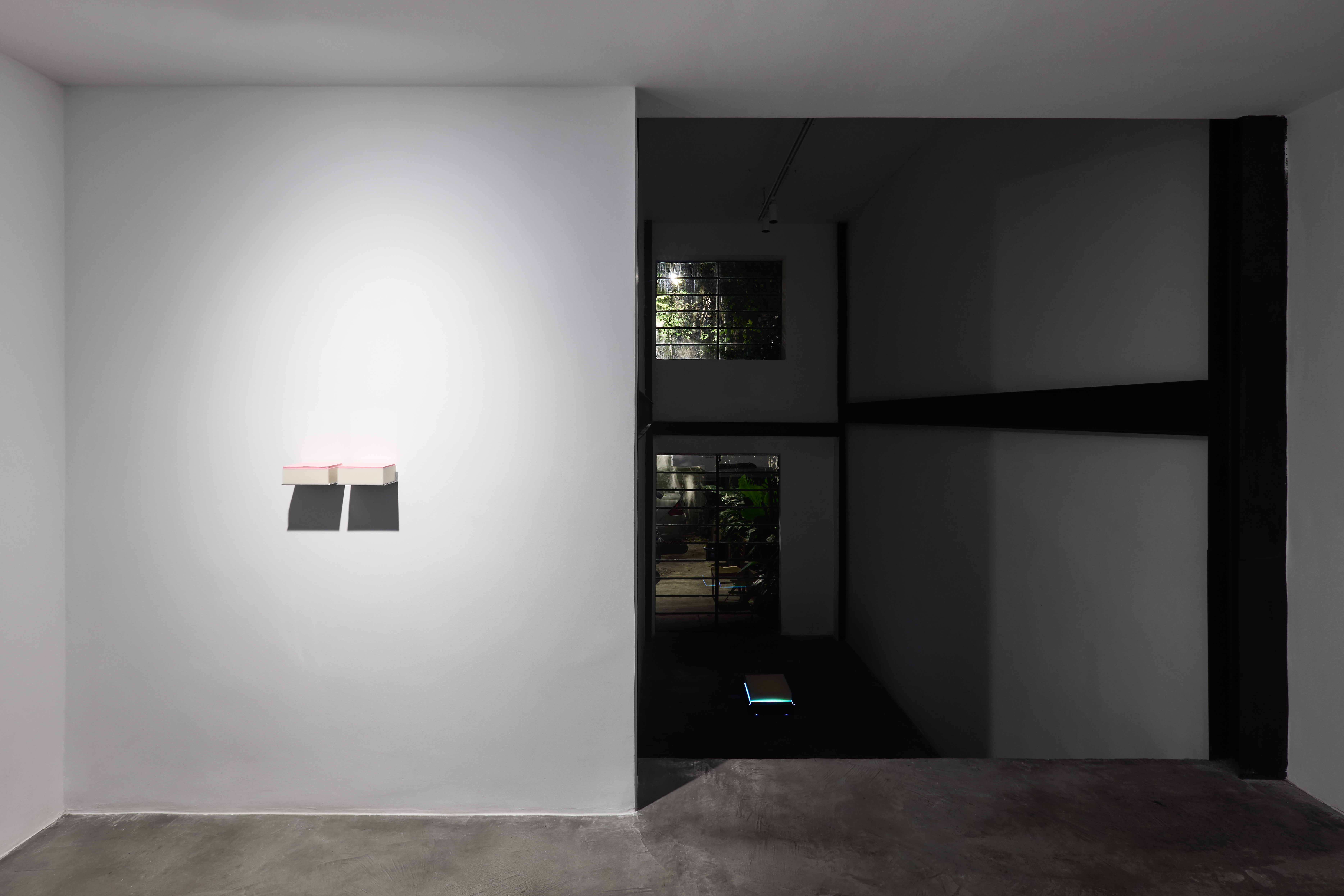
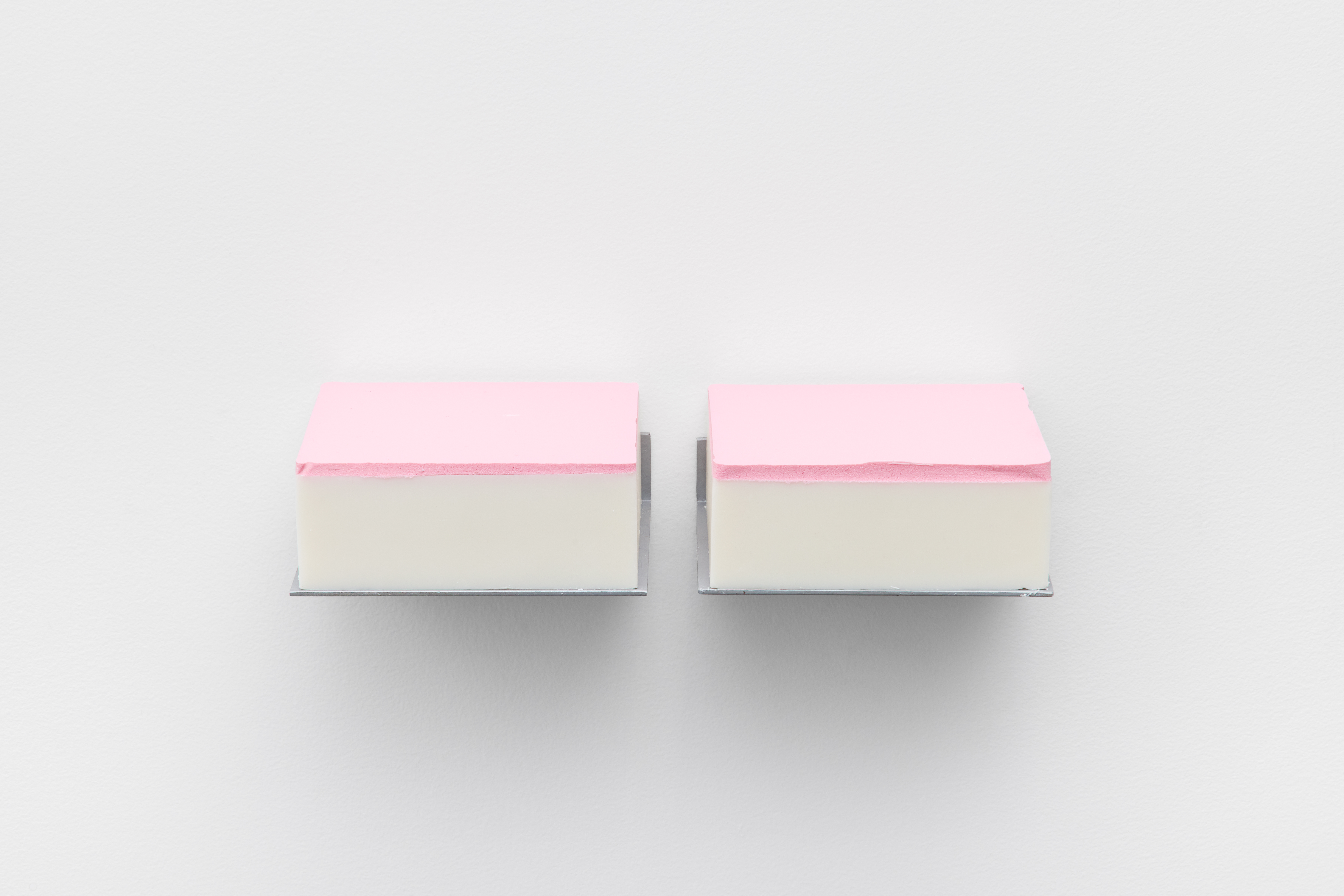
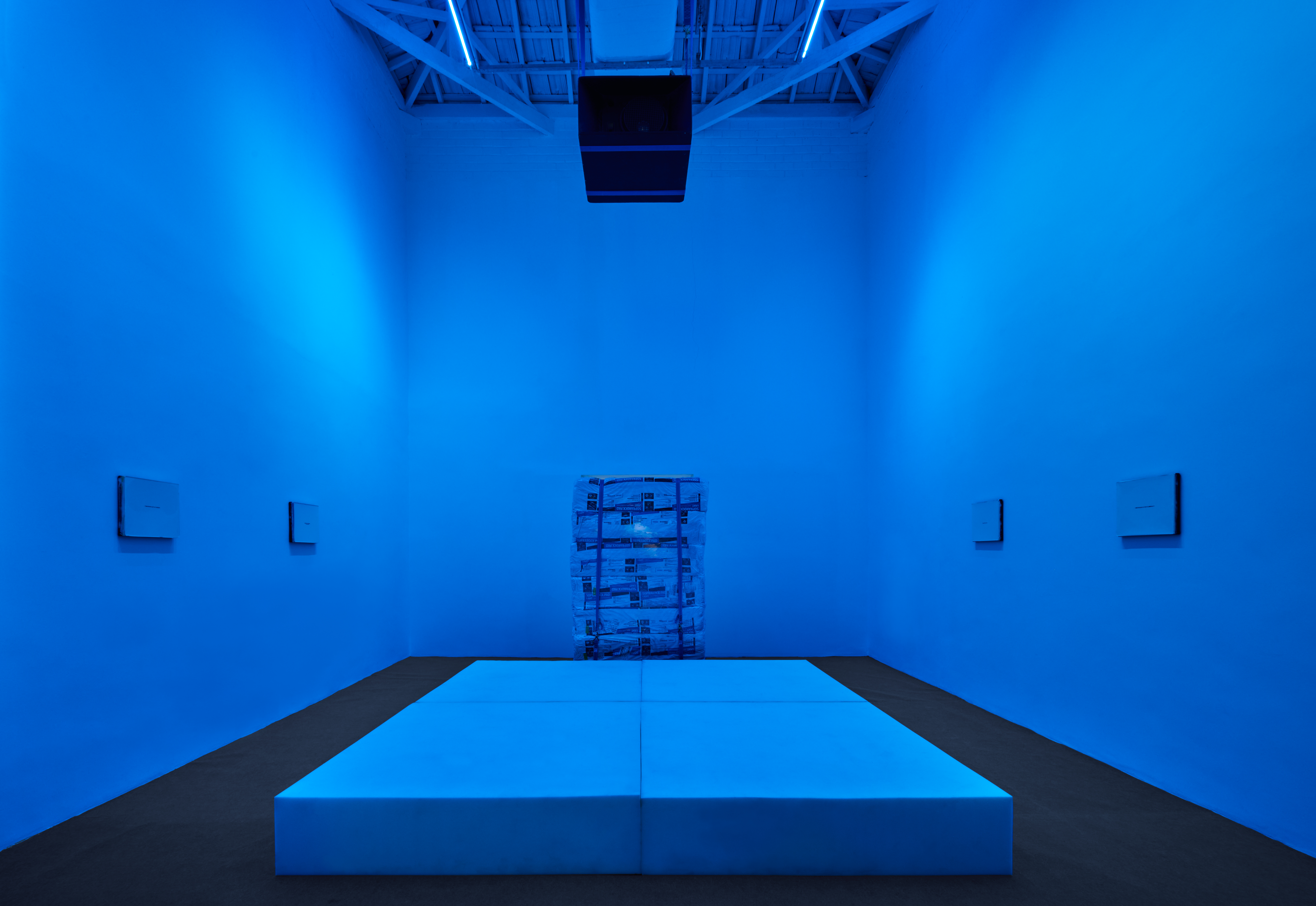
Activating this mnemonic dimension, Frontin proposes a large installation at the center of the gallery, where a blue carpet spreads across the space. She evokes, with precision, the specific condition of gathering (whether ritual, festivity, or mourning), the coming together of bodies and the concentration of human energy. The work reconstructs, in abstract form, the conditions that would give rise to a party, only to turn its spirit inside out. The body lingers between rest and ecstasy, between physical and spiritual suspension. Trance Continuum creates an environment of continuous sonic fields in which individuals (whether human or sonic) dissolve into a larger texture. Bodies that once existed in states of euphoria are invited instead to be received, to rest on foam blocks that suggest a dance floor, but now functioning as relaxing cushions. Elements of the rave dissolve their immediate symbolic clarity and, like sound itself, dissipate into a residual memory, suggested rather than declared. A light haze traverses the space, perceptible only when crossed by light, recalling the physicality of sound as a mechanical wave that propagates and occupies volume.
In the middle of the room, Frontin assembles a paradoxical chimera: she places together the emitter and the suppressor, what produces sound and what muffles it. It is created a space between a vintage speaker suspended from the ceiling and large-scale acoustic foam panels, as if pressing down upon the public itself, enacting spatially what the artist performs with sound. And then the people who choose to lie on the foam panels compress them. Frontin returns insistently to compression — of the body, of sound — as if infiltrating pores, tightening, verging on suffocation, attempting to fill the void left by the end of the party. Above these panels, hovering our heads, she installs a large speaker with ratched straps, stacked with the hard, utilitarian aesthetics of rave infrastructure usually relegated to the backstage. The speaker emits a textured, faintly abrasive, analog sound that contrasts with the ethereality of the dimly lit space and with the very principle of acoustic insulation. As the volume increases, fidelity degrades: as in sculpture or painting, scale demands a negotiation with detail. The sound travels through the exhibition space, but arrives muffled, as if remembered, distant, almost spectral. One carries the symptom of form: amplification and dampening repeat themselves together, as if insisting upon the ghost of a pulsating body.
Foam is filled with air. It is an ambiguous object, filled through vacancy. A counter-volume. A negative of the space it occupies. It densifies through void, absorbs through lightness. While traversing its acoustic properties, Frontin foregrounds its sculptural paradox, as well as its contemplative dimension, as if subtly inverting the expected relations between physical and metaphysical registers. Within this sonic chamber, whose limits remain indeterminate, these two elements confront one another — though not in the sense of facing. To face would presume a front, a privileged plane of vision, as in painting, where frontal address still organizes perception. Here, however, by interweaving principles drawn from sculpture and sound, they engage across multiple vectors and surfaces, radiating outward rather than aligning along a single axis, much like sound itself, which propagates spherically rather than frontally. Frontin thus reiterates a refusal of singular perspective, displacing the figure of the static observing body.
This repetition, approaching exhaustion, bordering on nonsense, and persisting despite the absence of progress (indeed, in the presence of wear), also drives the video presented in the exhibition. In a two-channel video in loop, Frontin films close friends under an embalmed blue light, repeating bodily actions to the point of fatigue, as if refusing an ending, as if responding to the beats of a party that does not end — and, for that very reason, becomes a kind of end-party. “Finished, it’s finished, nearly finished, it must be nearly finished.
The movement of the body becomes an end in itself, pointing back to itself as a teleological question, mirroring a mental non-place where restlessness persists. The subject deviates from rational order and, as if in a state of ecstatic dissociation, remains suspended in a machinic ending, in a certain emotional depletion, a repetitive post-traumatic monologue on the verge of collapse. And yet, this attenuation of the ego is desired: like someone who has spent eight hours at a party, it becomes a way of filling a void. One realizes that there is no escape from the ambient pressures of the world. At a moment when the humanizing possibilities of technology are under scrutiny — when artificial intelligence is being endowed with subjectivity — Frontin’s work raises another question: whether the human might become an automaton, relinquishing consciousness and understanding itself as a predictable machine. It is an existential endgame. A kind of hardcore continuum.
The repetitive movements of the bodies struggle both for themselves and against themselves, much like the suspended volume of the central installation: without consolation, it insistently pushes toward its maximum, straining to sound at full intensity even as dampening rises in equal measure, as if attempting to overcome a failure inherent to existence. The system crumples through the mutual annulment of its two primary forces, like a desiring body.
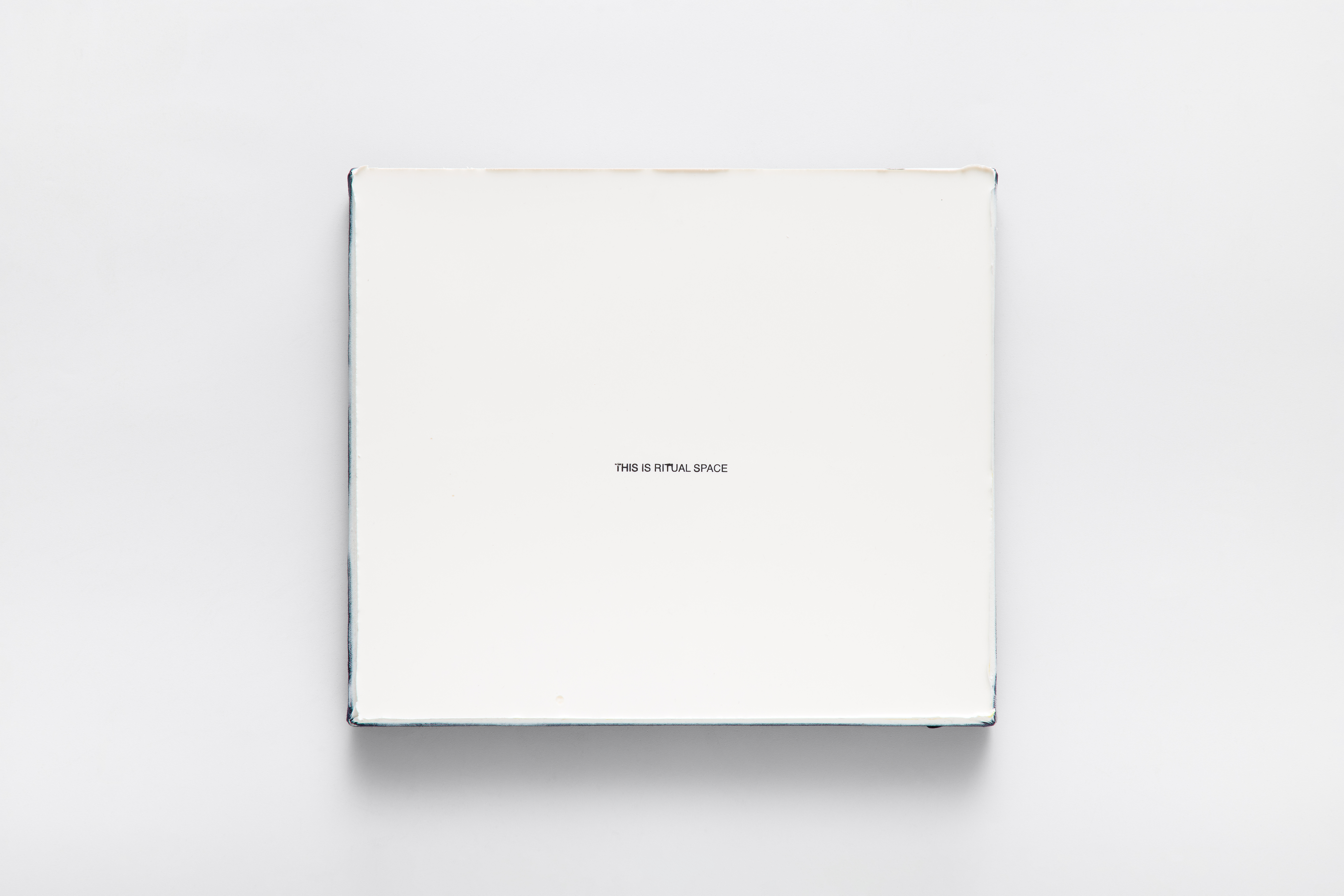
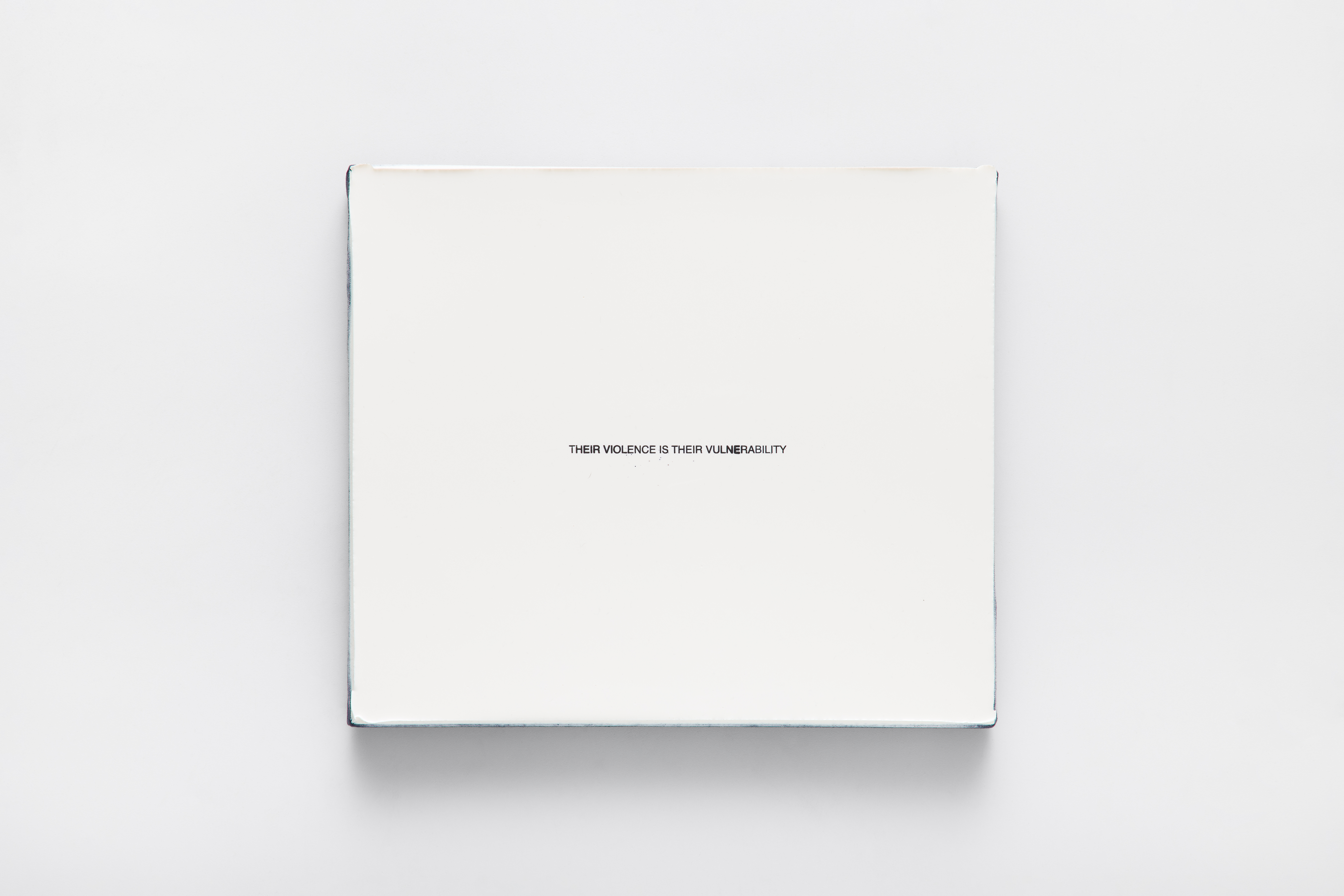
Distributed rhythmically across the gallery walls, Frontin presents works made with polyurethane resin on canvas, some bearing inscriptions — fragments of ideas and materials the artist has read — rendered in uppercase sans-serif typography, directly engaging a legacy of conceptual art. The use of resin intensifies the work by crystallizing a volume that hovers just in front of the canvas, insisting on the atmospheric occupation of a surface typically understood as flat. Like foam, the resin carries a near-color that slowly yellows, a subtle chromatic drift that registers time through delay rather than speed. This latent coloration behaves like a “vertical color of sound”, as if time and sound could accumulate and condense into matter — a dense repository of memory. The material, a liquid mixture that gradually solidifies through chemical reaction, captures a moment of fluidity and fixes it into stability. A fossilized event, in which transformation ceases yet remains legible. In this way, Frontin operates, both visually and sonically, through systems of gradual variation, constructing conditions in which time unfolds autonomously.
both visually and sonically, through systems of gradual variation, constructing conditions in which time unfolds autonomously.
Thomas Kaufmann